

Audit, Compliance and Quality of Service
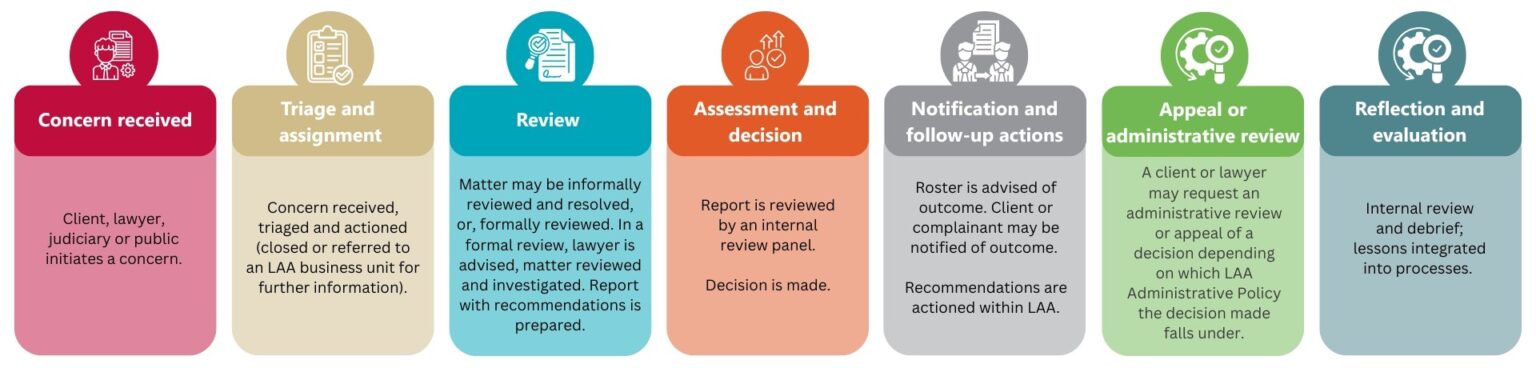
Compliance and Quality of Service process
Legal Aid Alberta (LAA) is committed to providing clients with knowledgeable, ethical and high-quality legal representation. We hold ourselves to the highest standards of professionalism and accountability through a clear compliance and quality of service process.
Most certificate-based services are not free, and clients are expected to reimburse LAA for services provided through certificate lawyers. As a publicly funded organization, LAA is accountable to the Government of Alberta and the Law Society of Alberta under the terms of the Governance Agreement. As such, LAA must ensure that lawyers’ accounts are complete and accurate.
Clients, lawyers, members of the judiciary and the public can submit billing or service concerns through an online form. Every submission is reviewed and may be actioned under LAA Administrative Policies.
Quality of service and compliance reviews ensure clients receive competent service and are accurately invoiced under the LAA Tariff of Fees. LAA’s Board Finance and Audit Committee provides oversight on these operations.
Consequences resulting from a quality of service or compliance review may include:
- Limit the nature of certificates offered to the lawyer
- Requirements for further education
- Require the lawyer to contact a practice advisor at the Law Society of Alberta to seek assistance in any defined subjects or areas of practice
- Conduct a compliance review of the lawyer’s accounts
- Suspension or removal from a panel or from the roster
- Stop issuance of certificates
- Repayment of the overpaid amount
- Set off any overpayments or unjustified payments against future payments to the lawyer
- Other steps that may be available to LAA under any roster lawyer agreement or otherwise
- Referral to Law Society of Alberta and/or law enforcement
While Legal Aid Alberta maintains its own quality and compliance processes, the Law Society of Alberta is the governing authority responsible for the regulation and discipline of lawyers, and matters involving professional conduct may be referred to the Society for review and potential action.
Notice: Upon becoming aware that the Law Society of Alberta (LSA) has issued a Notice of Citations regarding a roster lawyer, LAA will not issue any new Certificates to the member, including Duty Counsel Matters. Offers where the roster lawyer is indicated as Choice of Counsel will still be sent to them, and they can continue to work on their active certificates. It is the roster lawyers’ responsibility to advise LAA once your regulatory matters are concluded and provide the outcome.
Audit and Billing Process
As a publicly funded organization that is accountable to Albertans, LAA embraces the values of accountability and transparency. One aspect of accountability is ensuring that we’re good stewards of public money. LAA also needs to protect the interests of our vulnerable clients. As you know, our clients are required to repay LAA for the legal services provided by roster lawyers. To protect both the public and our clients, LAA needs to ensure that roster lawyer accounts comply with the Tariff and our other billing rules.
LAA operates on an honour-based system. In general, we don’t ask roster lawyers for detailed timesheets or receipts before we pay the account. But sometimes we’ll go back and take a closer look at certificates or invoices after we’ve paid, as part of a compliance review (audit).
Some invoices are reviewed because a client has complained, or because we’ve identified an unusual charge or disbursement. In other cases, we’ll randomly select some roster lawyers or certificates for a closer look.
As a proportion of the many thousands of certificates we issue every year, we don’t audit many files. But when we do, we need your co-operation by providing us with the supporting records we request.
Important Things to Remember about Billing and Audits
LAA has longstanding principles and practices surrounding invoices and audits:
- We can audit your accounts up to three years after you’ve submitted your final invoice. As a result, we need you to keep supporting records, documents, and receipts for at least four years after you’ve final-billed an account.
- You need to keep time records whenever you bill LAA for an hourly Tariff item. LAA may ask you to provide this timesheet either before or after we pay your account. Your timesheet should be just as detailed as any timesheet you’d keep for a private client.
- If LAA approves “extra hours” beyond what is allowed by the Tariff, this doesn’t mean you are automatically entitled to bill LAA for the full hours we’ve approved. You still need to keep a timesheet documenting your actual time spent working on the file, and you need to send us that timesheet upon request.
- In some cases, our policies allow you to delegate work to another lawyer. If you delegate work, you need to make sure that lawyer keeps the same records you’re required to maintain.
- When the Tariff indicates a disbursement can be billed at “actual cost,” the Tariff means exactly what it says: you can bill your actual, out-of-pocket costs attributable specifically to that certificate matter. You can’t spread your general office expenses between many different clients by dividing an overhead expense between certificates as a disbursement. We might ask you for receipts to prove your disbursements, so hang on to them.
- You need to respond to our requests for supporting records. We appreciate the many demands on your time – and we’re often flexible if you need an extension – but non-responsiveness is unacceptable. If you don’t respond to our requests for records within a reasonable time, LAA will stop issuing you certificates until we’re satisfied that we’ve received the records we need for the audit.
- If we identify an irregularity, or if you can’t provide records to justify your billing or disbursements, LAA has different options. We might disallow some of your billings and set off any overpayments against your future billings. In some cases, we might suspend or remove you from the roster.