

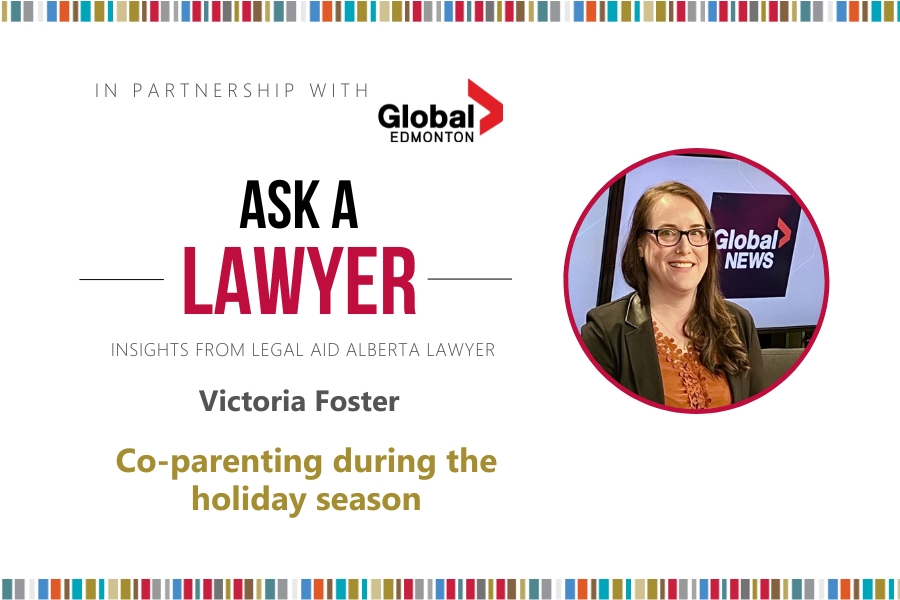
The winter holiday season is a special – and stressful – time of year. For families who are co-parenting, especially for the first time, there’s pressure to make the holidays memorable for kids while co-ordinating with the other parent.
The best tip for parents, says LAA staff lawyer Victoria Foster, is to put the best interests of their children first.
Foster appeared on the Global Morning News Ask A Lawyer segment to discuss the legal issues surrounding co-parenting during the holiday season.
View the segment:
Transcript:
Erin Chalmers: It is a special time of year, but it can also be very stressful for families that are co-parenting, especially for the first time, there is pressure to make the holidays memorable for kids while co-ordinating with the other parent here today to talk about the legal side of co-parenting is Legal Aid Alberta staff lawyer Victoria Foster. Thank you so much for being here.
Victoria Foster: Thank you.
Chalmers: What is the one thing, that for parents who are separated or divorced, should they be focusing on as we head into this holiday season?
Foster: So definitely their kids. If they can put the needs of their kids first, then they’re going to be successful. A big part of what I do in my practice, about 90 per cent, is represent kids in separation and divorce. And the things that I hear most from kids are ‘I don’t want to be involved in adult decisions, I want my parents to keep adult conversations and decisions away from me, and also I want to see both of my parents.’ I think it’s important to remember that the courts only consider the best interests of the children when they are making any parenting decisions and so the parents need to do that also, and really these types of plans for holidays should be made months in advance if possible. It’s almost too late now to get into court for any holiday-related issue, and you don’t want to go to court anyway because you’re giving your decision-making power away to a judge about your family, about your children, and then you have to live with that decision even if you don’t like it.
Chalmers: Right – so they’ll go obviously is to work together, but what do you do if, say, one parent is really digging in their heels about certain issue?
Foster: I mean, if they have a court order then obviously the expectation is that that would be followed. If they don’t have an agreement or court order then they can try using a mediator who would facilitate a resolution. If that’s not possible, they can hire an arbitrator who is like a private judge and who will make a decision for the family – but of course that comes with additional financial costs, and then you’re giving away your decision-making power again to somebody else.
Chalmers: So for families that are co-parenting or divorced, and say one wants to travel – maybe take a trip out of the country even – is there anything that they need to be aware of as far as documentation, leaving the country without the father or the mother with them?
Foster: Yeah, so there’s a couple things to consider: the first is whether the country you’re traveling to is part of The Hague Convention, and that’s an international law that deals with child abduction and ensures that children can get back to their home country; the second thing is whether or not our federal government has issued any travel advisories – those are available on the Internet – and it’ll say whether government says ‘Yes travel freely’ or if there’s any advisories to the trouble or to the country that you’re going to, and then you will need travel consent letter from the parent who’s not going with you, just saying that they allow that travel. And then, if you’re traveling within Canada, then we always suggest to people to have something in writing from the other parent, whether it’s a text or e-mail or something just saying that they do agree to that travel. And it’s especially important if people have a police-enforceable parenting order and they’re traveling on the other parent’s time.
Chalmers: What is a police-enforceable order?
Foster: Yeah so if you, it’s an order that the police can enforce so if you breach it, if you don’t have the children to the other parent, for their parenting time, that person can phone the police and the police can go and get the kids. And so you can imagine if you’re in Toronto and you have police showing up the airport that can be pretty chaotic.
Chalmers: Yes for sure, and you mentioned the travel advisory. So if there’s a travel advisory for a place that you want to go, does that kind of cancel out your you being able to go?
Foster: It doesn’t cancel it out but it’s certainly an argument that the other party could say ‘I don’t want you going there’.
Chalmers: OK. the other common issues this time of year are financial ones, especially right now for a lot of people with inflation. Does that also lead to more issues when it comes to spousal support?
Foster: Yeah so I mean if you have an order for any type of support child or spousal support again the expectation is that that’s followed, and the holidays don’t change that. The things to consider are like holiday expenses like gifts those are your own responsibility but if there’s extra childcare needs when schools are closed or whatever then that becomes a shareable expense and something that needs to be discussed between the parents.
Chalmers: And I would imagine too, when it comes to buying gifts and stuff there’s always that, bonus in having that conversation with your ex about ‘How much are we spending?’ so one person isn’t going over the top trying to appease and the other is left kind of sitting there with just the one gift.
Foster: Exactly. And if you can do it together then – better!
Chalmers: Have those conversations yeah, co-parenting always leads to a better situation for children. Thank you so much for coming on the show to chat about this, I appreciate it.
Legal Aid Alberta lawyers specialize in family law, child welfare, domestic violence, immigration and youth and adult criminal defence. If you have a question for a lawyer send it to: mailto:[email protected]